

Sourcing note, same practice as always: I checked these against the actual pages rather than a search snippet, so what’s below is what’s really there. Links are in the text as you go, and again in the list at the end.
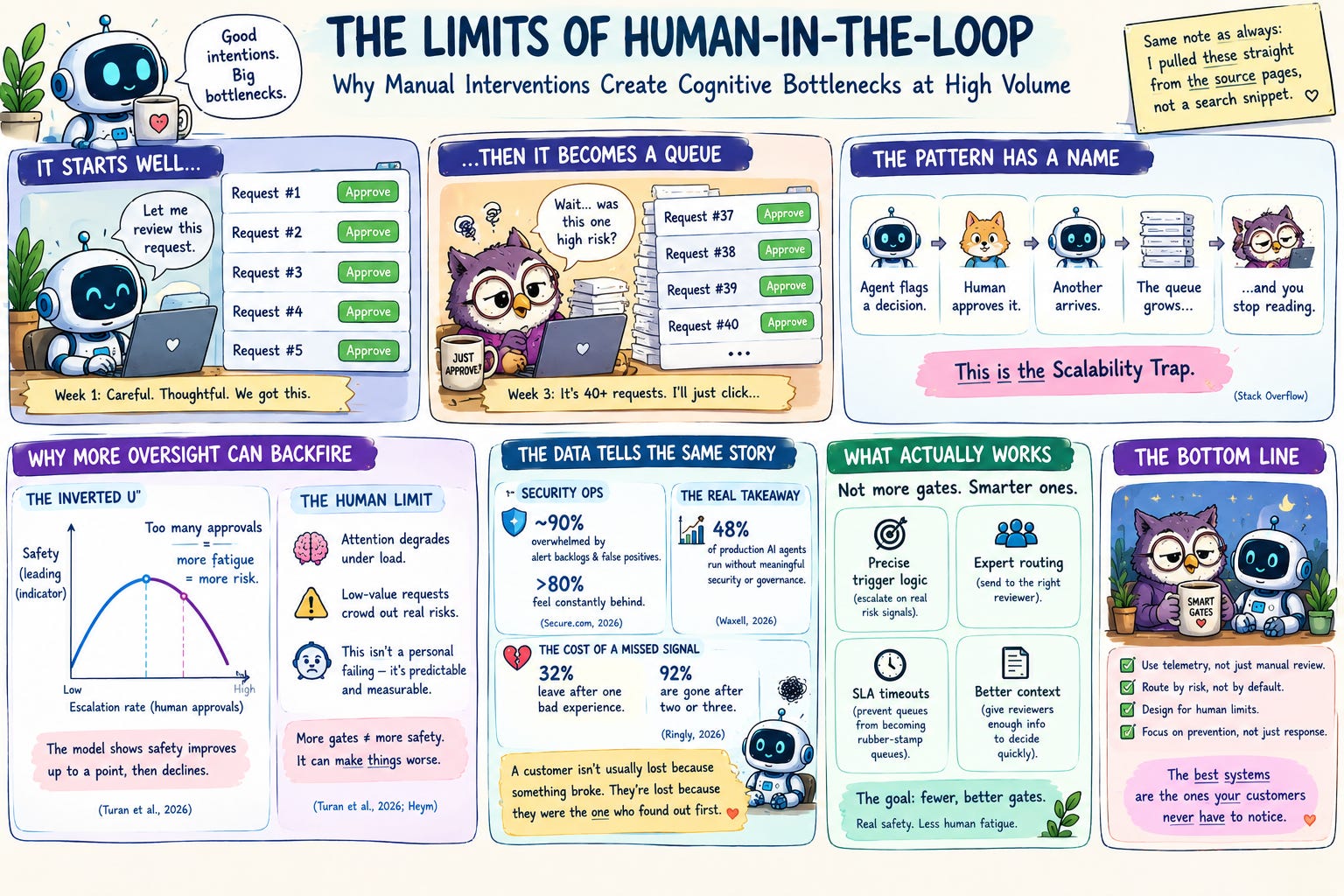
I want to describe a very specific moment, because I think almost everyone reading this has lived through some version of it. You set up an approval gate for a new agent, feeling responsible and careful. Every consequential action pauses and waits for a human yes. For the first week, you read every single request closely. By week three, you’re clicking approve without really reading the payload anymore, because there are forty of them in your queue and you have an actual job to do.
That’s not a personal failing. It’s a predictable, well-documented outcome, and 2026 is the year it stopped being a hunch and became something people actually measured.
The pattern has a name now, and it’s not a new one
A piece from Stack Overflow’s engineering blog names the failure mode plainly. In development environments and low-frequency pipelines, routing uncertain decisions to a human is a defensible design. But in production systems running at real scale, dozens of agents, hundreds of decisions an hour, it becomes what the piece calls the Scalability Trap. Their description of how it actually breaks down is worth reading closely: an agent flags a decision, a human approves it, then another arrives, then dozens more, the queue grows, and the human begins clicking through without reading the payloads anymore (Stack Overflow).
This isn’t a hypothetical. WitnessAI’s research on 2026 AI security trends predicts almost exactly this pattern will define the year, describing how companies that initially require human approval for every consequential agent action will see users bombarded with thousands of permission requests daily, leading them to mindlessly click through or simply switch on an “auto-approve” setting to make the interruptions stop. Their comparison to an earlier failure is the one that stuck with me, that this is the same desensitization security teams already watched happen with alert fatigue, just showing up again in a new form (WitnessAI).
The security operations world has actually been living this for years already, which makes it a useful preview of what’s coming for everyone else. A 2026 industry survey found that almost 90 percent of security operations centers report being overwhelmed by alert backlogs and false positives, with more than 80 percent of analysts saying they feel constantly behind. A separate 2026 survey found 76 percent of SOC teams naming alert fatigue as a top operational challenge, and 73 percent reporting analyst burnout as a direct consequence (Secure.com). Stack an agent that asks for approval on every move onto a team already in that state, and you’re not adding a safety layer. You’re adding a second, faster-moving fatigue engine on top of the first one.
Why more oversight can quietly make a system less safe
Here’s the part I found the most genuinely counterintuitive, and it traces back to an actual modeling study rather than an anecdote. A June 2026 paper called “Oversight Has a Capacity” took the standard approval-gate pattern and questioned two assumptions almost every guide makes, that there’s a ground truth about which actions are risky, and that the reviewer is a perfect, always-available oracle. When the researchers modeled the reviewer honestly, as someone whose attention degrades under load, they found that realized safety follows an inverted U shape as the escalation rate rises. Past a certain point, sending more actions to a human for approval doesn’t make the system safer. It makes it less safe, because the reviewer’s fatigue costs more than the extra scrutiny buys (Turan et al., arXiv; summarized well by Heym).
The paper’s authors are careful, and I think it’s worth passing along their caution rather than smoothing it over, that this inverted U and the attack scenario it implies are modeling results meant to motivate further human study, not directly measured outcomes. But the attack scenario itself is genuinely worth taking seriously even as a hypothesis. If a reviewer’s attention degrades predictably under volume, an adversary, or honestly just an overly cautious set of trigger rules, can flood the queue with low-stakes requests specifically to exhaust the reviewer before slipping something real through to a person who’s stopped actually reading (Turan et al., arXiv). A piece on HackerNoon points out that this exact scenario, “Overwhelming HITL,” is now formally classified as a deliberate attack vector in the OWASP Agentic AI Threats and Mitigations Guide (HackerNoon).
The math genuinely doesn’t scale
Beyond the psychology, there’s a much simpler arithmetic problem. Gartner projects that 40 percent of enterprise applications will embed AI agents by the end of 2026. If even a modest share of what those agents do generates a human checkpoint, the same HackerNoon piece makes an observation I think understates how serious it is: the human oversight workforce needed to staff that volume meaningfully simply doesn’t exist. You cannot hire your way out of a bottleneck that scales with agent throughput while your review capacity scales, at best, linearly with headcount (HackerNoon).
A piece from Towards AI frames the underlying constraint in a way I found clarifying, that human throughput is bounded and scales linearly at best, while data volume and model capacity scale much faster, which means annotation and review inevitably become the pipeline’s bottleneck as volume grows (Anis Aknouche, Towards AI). And the consequence of ignoring that constraint isn’t neutral. It’s actively worse than having no gate at all in some cases, because a report from April 2026 on the state of AI agent security found that 48 percent of production AI agents are running without meaningful security or governance, meaning nearly half of deployed agents already operate with essentially no working oversight, formal gate or not (Waxell).
What actually works instead of more gates
I don’t think the honest answer here is “remove human oversight.” I think it’s “stop treating every action as equally worth a human’s attention,” which is a different and much more tractable problem.
The Waxell piece lays out three design changes that consistently reduce fatigue without reducing real safety: precise trigger logic that escalates based on actual risk signals rather than broad action categories, routing reviewers by their actual expertise so people see fewer irrelevant escalations, and SLA-enforced timeouts so an unresolved queue doesn’t quietly become a rubber-stamp queue by default. The same piece offers a simple diagnostic worth stealing, that an approval rate consistently above 90 percent is itself a signal your triggers are too broad and are burying real risk in noise (Waxell).
The arXiv-grounded piece makes a similar recommendation from the safety-modeling side: gate fewer actions, but make each gate carry meaningfully more information, so the reviewer isn’t forced to go dig for context that could have been in the request from the start. It also suggests giving repeated, identical tool calls an approval scope, so the second and third instance of the same low-risk action doesn’t re-pause the system for a decision that’s already effectively been made (Turan et al., arXiv).
The Towards AI piece names the broader shift underneath all of this well, describing supervision moving from reviewing every model output toward governing actions through checkpoints, approval gates, rollback mechanisms, monitoring triggers, sometimes called “human over the loop” rather than strictly in it. The framing I found most useful from that piece is that the human isn’t a fail-safe bolted onto the system after the fact. The human is part of the system, with a performance curve of their own, and if you design around that curve instead of ignoring it, the loop actually holds (Anis Aknouche, Towards AI).
Where I land on this
I think the honest reframe is that scaling velocity doesn’t mean giving up control, it means giving up the illusion that pausing for a human on every action was ever real control to begin with. A gate that gets rubber-stamped a hundred times a day isn’t oversight. It’s theater with a false sense of safety attached, and the data from security operations teams suggests that theater actively degrades the humans running it. Real governance at scale looks more like telemetry, precise routing, and a small number of gates that actually matter, each one carrying enough context that a tired human can still make a real decision when it counts.
If your team has tuned an approval system down from “gate everything” to something narrower and it’s held up under real volume, I’d genuinely like to know what the triggers ended up looking like. This is the kind of problem where the working answer is usually more specific and less elegant than the diagrams suggest, and I’d rather hear what actually survived contact with a live queue.
References
Stack Overflow Blog. Dispatches from O’Reilly: From Capabilities to Responsibilities.
WitnessAI. Why Human Behavior, Not AI, Will Drive 2026’s Biggest AI Failures.
Secure.com. Approval Fatigue Is Quietly Breaking Your AI SOC.
Turan, E. et al. Oversight Has a Capacity: Calibrating Agent Guards to a Subjective, Fatiguing Human (arXiv preprint, 2026).
HackerNoon. The Oversight Fatigue Problem: Why HITL Breaks Down at Scale and What Comes After.
Anis Aknouche, Towards AI. Human in the Loop and Cognitive Load Fatigue.
Waxell. AI Agent Approval Workflows: Human Oversight That Scales (2026).